Blade inspection · Budget framework
Not yet translated. These links open the resource library in that language:EspañolPortuguêsDeutschالعربية
Blade Inspection Robot Cost: A Budget Framework
Equipment, training and operating factors. No honest price exists without a defined package and scope, so budget per accepted inspection.
Separate the configuration price from the cost of an accepted inspection. This article provides a variable-based planning framework, not quoted pricing or an ROI claim.
Define the inspection unit first
A price “per inspection” is ambiguous. It could mean one cavity, one blade, three blades on one turbine or a visit that includes several methods. Choose one unit and specify what makes it complete.
For example, your contractual unit could be one blade with specified internal areas captured, exclusions documented and a reviewed report accepted. That is a proposed scope definition, not a claim about what a particular robot can deliver. What “accepted” should mean is set out inwhat a blade inspection report should include.
Keep exterior inspection, additional nondestructive testing, engineering assessment and repair outside that unit unless explicitly included. Otherwise, two bids can look comparable while delivering different evidence.
Separate the purchase package from annual costs
Ask suppliers to itemize the proposed configuration and exclusions. TheWIT-BR60 product page specifically directs buyers to confirm included equipment, accessories, responsibilities, records and delivery arrangements in the quotation. A published specification does not define a complete supply package.
Use the following budget worksheet to organize quotes and internal estimates.
| Cost category | Inputs to request or estimate | Common scope question |
|---|---|---|
| Acquisition | Robot, controller, cameras, cables, transport cases and selected accessories | Which items are included? |
| Initial deployment | Freight, import costs, commissioning and acceptance activity | Who pays for site setup? |
| Training | Instructor fees, trainee labor, travel and supervised practice | How is competence assessed? |
| Field operations | Crew hours, travel, accommodation and access support | Who prepares the turbine? |
| Reporting | Review labor, software, storage and agreed exports | Who approves the findings? |
| Maintenance | Consumables, replacement parts, servicing and support | What is covered by warranty? |
| Availability | Repair lead times, backup arrangements and weather disruption | What happens if deployment fails? |
Treat recoverable taxes consistently with your finance policy. Record currency, quotation validity and payment milestones rather than mixing estimates from different commercial bases.
Build an annualised planning model
Let:
- A = installed acquisition cost, including initial deployment
- S = assumed residual value at the end of the planning life
- L = planning life in years
- T₀ = initial training cost, including trainee time
- Lₜ = years over which initial training is allocated
- F = other annual fixed costs, including recurring training, software and scheduled support
- N = accepted inspection units delivered per year
- V = average variable operating cost per accepted unit
Then a simple annual cost allocation is:
Annual fixed allocation = (A − S) / L + T₀ / Lₜ + F
Direct cost per accepted unit = annual fixed allocation / N + V
This is a management-planning model. It is not a tax-depreciation calculation, cash-flow forecast or financing valuation. Validate useful life, residual value and allocation periods with your finance team. If ownership financing is relevant, model its treatment separately and avoid counting the same capital cost twice.
Build V from field labor, allocated mobilization, travel, consumables, variable maintenance, reporting labor and usage-based fees. Allocate shared trip costs consistently. Include unsuccessful visits and rework in the budget; do not hide them by counting only successful capture time.
Budget for training beyond the controls
Operator familiarization and competent field execution are different budget items. Depending on the task, teams may need instruction in setup, insertion and recovery, image-quality checks, location recording, equipment care and abnormal-condition response. Reporting personnel need the agreed classification and escalation workflow.
Existing site-access and safety requirements still apply.OSHA’s wind-energy lockout/tagout guidance identifies hazardous-energy control as a requirement for relevant servicing and maintenance activities in the United States. Budget for the applicable local and site procedures; robot training does not replace them. The deployment and recovery planning guide sets out who approves what.
Ask whether refresher instruction, replacement operators and supervised initial deployments are included. Staff turnover can make recurring training a meaningful annual expense.
Model downtime separately and carefully
A robot’s capture duration is not the turbine’s total outage. Planning may also involve access, isolation, positioning, insertion, recovery, checks and authorized return to service.
The WIT-BR60 page publishes a 70 m run in no more than 60 minutes for one cavity under its stated setup and unobstructed-path conditions. That is not an end-to-end turbine inspection duration or a universal scheduling allowance.
For an economic scenario, define:
Downtime impact = incremental unavailable hours × expected counterfactual average power × net energy value
Use hours, megawatts and currency per megawatt-hour consistently. Counterfactual power means the generation reasonably expected without this inspection, not turbine nameplate power. Consider curtailment and an already-planned outage. Charge only incremental downtime once, and keep energy-value assumptions separate from supplier charges.
Test utilisation before comparing ownership and service
Utilisation changes the fixed-cost allocation. With the same annual fixed allocation, halving accepted annual volume doubles its fixed-cost component per unit. It does not necessarily double the total unit cost because variable costs may change too.
Build conservative, expected and higher-utilisation scenarios using your own inputs. Check:
- How many planned visits can actually be completed?
- Are blade geometries and access conditions compatible? Start from the access and compatibility checklist.
- How much time is lost to travel, weather or repair?
- Can the review team process the captured material?
- Will extra capacity require another crew or robot?
Compare ownership, rental and an inspection service only when available offers cover equivalent scope, evidence access, review responsibility and acceptance requirements. The lowest purchase price may not produce the lowest accepted-unit cost.
Where to go next
Next steps from this guide
Keep reading
- Internal Blade Inspection Robot: Access ChecklistCheck compatibility first: a robot that cannot enter or traverse the blade has no cost per accepted unit.
- Blade Inspection Robot Deployment and RecoveryThe responsibilities and contingencies behind the field-operations and availability lines.
- Sample Blade Inspection Report StructureReview the sample report structure alongside the equipment scope, so the budget covers a usable record.
Product
WIT-BR60 internal blade inspection robot
The “Confirm before ordering” note lists what a quotation must itemise. Published specifications do not define a complete supply package.
Next step
Request a scope-based quotation
Blade models, access conditions, annual volume, locations and reporting workflow let an itemised quotation be written against your unit.
Part of the wind turbine blade inspection guide path.
Evidence register
Sources and limitations
The formulas are an editorial planning model. The product page is first-party; the external reference covers hazardous-energy control for the United States.
- OSHA — Wind energy: lockout/tagout — hazardous-energy control for servicing and maintenance in the United States.
- WIT-BR60 product page, “Confirm before ordering” — items a project quotation should itemise; published specifications do not define a complete supply package.
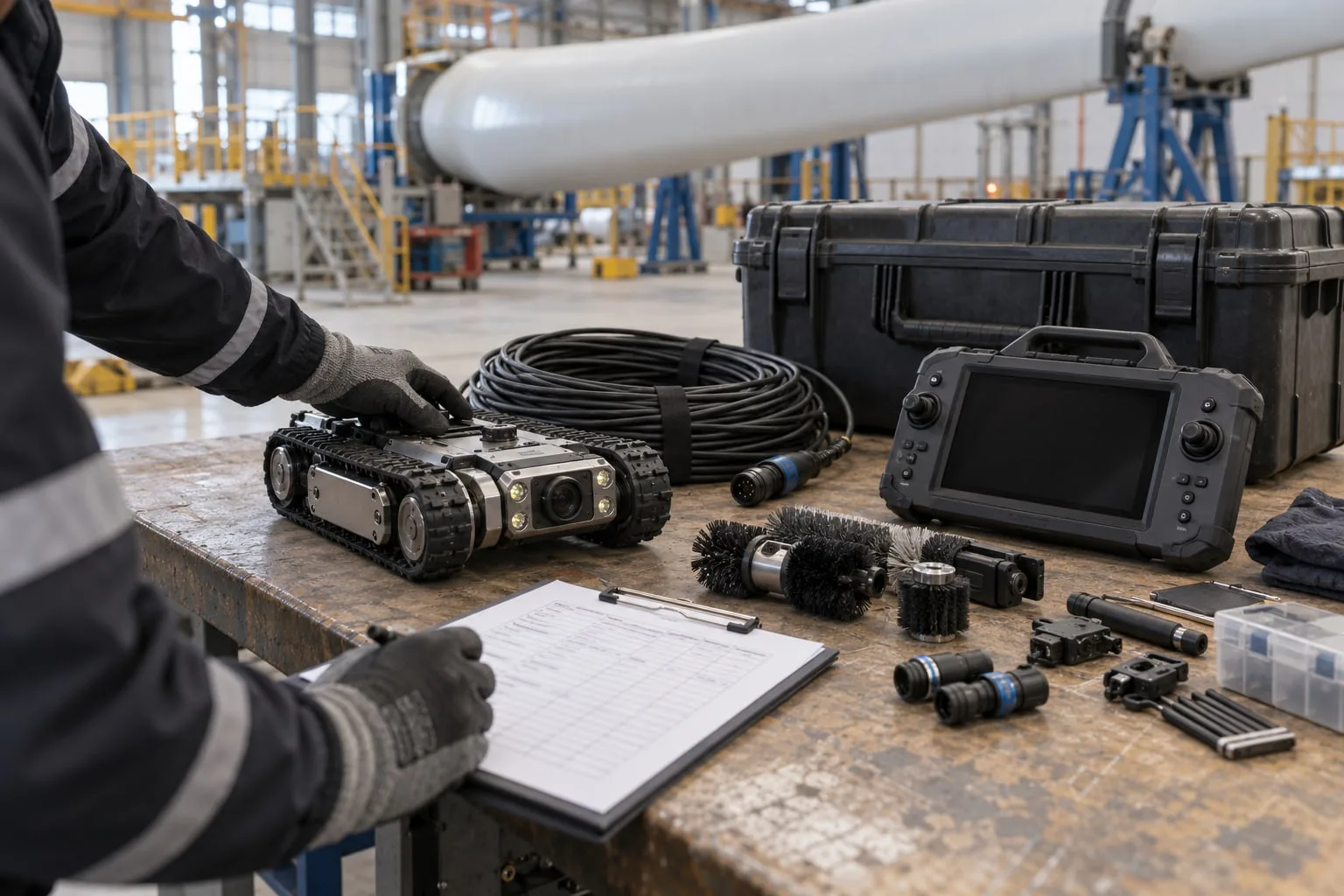
Limitation: this page contains no price, quotation, ROI or payback figure for any product, and no market range, because none is supported by a published source. The formulas are for management planning, not tax, cash-flow or financing treatment. OSHA is a United States reference. The page has not been approved by a named engineer or reviewed by finance. The illustration is generic.
See the source and editorial policy for how product values, external references and review status are kept separate.
Decision support
Frequently asked questions
Is there a reliable standard market price?
Not without a defined configuration and commercial scope. Obtain an itemized quotation instead of treating a generic internet range as a purchase budget.
Does automated reporting remove review labor?
Do not assume so. Include human verification, resolution of uncertain findings and final report preparation. Confirm which outputs the proposed configuration actually supports.
How should maintenance be estimated before ownership?
Request service intervals, consumable lists, warranty exclusions, parts availability and support terms. Record any remaining allowance as an assumption and test its sensitivity.
Does this page give a price or a payback period for the WIT-BR60?
No. The product document publishes no price, quotation terms, ROI or payback figure, so none is stated here. The page gives the variables a budget needs; the numbers come from an itemized quotation and your own assumptions.
Engineering review
Request a scope-based quotation
Share blade models, access conditions, annual inspection volume, deployment locations and the reporting workflow you need, so the budget covers data collection and a usable final record.