Blade inspection · Reporting and acceptance
Not yet translated. These links open the resource library in that language:EspañolPortuguêsDeutschالعربية
Blade Inspection Report: What It Should Include
What should a wind turbine blade inspection report include? Asset, scope, evidence-linked findings, what was not inspected and who reviewed it.
A later reviewer may not have been on site. Marked-up photographs alone cannot explain an uncertain location or an inaccessible cavity.
Start with the decision the report must support
Before collecting images, agree whether the inspection supports baseline documentation, investigation of a known concern, a maintenance review or comparison with an earlier inspection. These objectives can require different views, location accuracy and review responsibilities.
Define the deliverables with the owner and responsible technical reviewer. Confirm the inspection procedure, asset-specific criteria and required approval route. A generic template should not invent repair thresholds or imply that an image alone authorizes continued operation.
DNV-ST-0376 provides principles and technical requirements for wind turbine rotor blades. Referencing a standard does not establish that a particular report or inspection robot conforms to it. The applicable edition, contractual requirements and inspection procedure still need project-specific review.
Use a practical report structure
The following is a proposed procurement and quality-check framework, rather than a mandatory standard template.
| Report section | Minimum useful content | Question it should answer |
|---|---|---|
| Document control | Report ID, revision, issue status, author and actual approvals | Is this the current authorized record? |
| Asset identity | Site, turbine ID, blade identifier, model and relevant history | Which component was inspected? |
| Scope | Objective, surfaces, cavities, method and planned boundaries | What work was requested? |
| Execution context | Inspection time, equipment configuration, access and visibility | Under what conditions was evidence captured? |
| Coverage | Planned versus achieved areas, exclusions and reasons | What remains unknown? |
| Evidence register | Capture IDs, original files, location references and annotations | Can another reviewer retrieve the evidence? |
| Findings | Observations, supported measurements and review status | What was actually seen? |
| Assessment and actions | Criteria, reviewer conclusions, recommendations and owner decisions | Who must do what next? |
An executive summary should surface urgent escalations and unresolved limitations.
Keep four information layers separate
1. Original capture
Retain the original image or video and a stable identifier. Record its relationship to the turbine, blade and inspection session. Preserve enough context to understand the camera view, rather than supplying only a tightly cropped feature. Identify edited derivatives as derivatives.
2. Annotation and automated assistance
Store overlays, labels and candidate detections separately from originals. Record whether an annotation came from software or a person. Where available, retain the software or model version and processing settings needed to interpret the result. An automated confidence score should not become a structural severity grade by default.
3. Human interpretation
Record whether the reviewer accepted, rejected or could not resolve each candidate. Describe uncertainty explicitly. A visible line may require further examination before it can be classified as damage. Include the criteria used and the reviewer’s actual role; leave approval pending until it occurs.
4. Owner decision
Keep the engineering recommendation distinct from the owner’s authorized action. A recommendation to investigate is not a completed investigation. Add an action owner, due date where agreed, and closure evidence when the work finishes.
WindInspectTech’s sample inspection report illustrates this separation and provides blank planning fields. It contains no customer inspection results and does not establish compatibility with a particular export workflow.
Make locations and measurements reproducible
Define the coordinate convention before mobilization. State how blades are identified, where distances originate, which cavity is being described and how the inspected surface is named. Link each observation to both a context view and its detailed evidence where possible.
Distinguish estimated position from measured position. If a dimension is reported, include the method, unit and relevant uncertainty or limitations. Pixel dimensions alone do not establish physical defect size. When measurement is unavailable, describe the visible feature without inventing a length or depth.
For repeat inspections, record how the team matched the current location with the earlier observation. A changed viewing angle or lighting condition can change appearance without demonstrating physical growth.
Report coverage honestly
Coverage needs a denominator: planned area, defined surface, accessible cavity or agreed inspection path. Distance travelled is not automatically surface coverage. Neither an equipment specification nor a successful traversal proves that every required feature was visible. The full argument is in the guide tointernal blade inspection coverage.
Use separate statuses for:
- Inspected with evidence suitable for the agreed review
- Captured, but limited by visibility or image quality
- Accessible, but not inspected during this visit
- Inaccessible or outside the agreed scope
Explain obstructions, interrupted runs, missing location references and other exclusions. “No finding recorded” and “not inspected” must remain distinguishable. An exclusion should trace back to the access pack built before mobilisation; theaccess and compatibility checklist shows what that pack records.
The WIT-BR60 product page describes internal visual capture and a human-reviewed reporting workflow. Its documented coverage and timing statements are conditional product values, not proof of a specific project’s achieved coverage.
Apply a release checklist
Before issuing the report, check that:
- Every finding points to a retrievable original file
- Blade identifiers and coordinate conventions are consistent
- Annotated copies cannot be mistaken for originals
- Missing data and inaccessible areas are visible
- Classifications cite the agreed criteria
- Review and approval states reflect work actually completed
- Recommendations have a clear recipient and escalation route
- The owner can open the delivered files and retain them as agreed
Agree retention, access permissions and revision handling in advance. A corrected report should preserve the reason for the change and identify which version it replaces.
Where to go next
Next steps from this guide
Keep reading
- Sample Blade Inspection Report StructureSee these fields laid out as an illustrative record, with blank CSV templates you can adapt.
- Blade Inspection Robot Cost: A Budget FrameworkBudget for the review labour and reporting this guide asks for, not just the equipment.
Product
WIT-BR60 internal blade inspection robot
Documented capture, review and reporting workflow, with the conditions attached to each product value.
Next step
Blade identifiers, coverage requirements, review criteria and preferred file formats let the evidence and approval route be agreed first.
Part of the wind turbine blade inspection guide path.
Evidence register
Sources and limitations
The report structure is an editorial framework. The one external reference describes where blade requirements come from; the product and sample-report pages on this site are first-party.
- DNV-ST-0376 — Rotor blades for wind turbines: principles and technical requirements for wind turbine rotor blades.
- Sample blade inspection report structure — an illustrative record and blank templates on this site; no customer results.
- WIT-BR60 product page — first-party product-document values and their conditions.
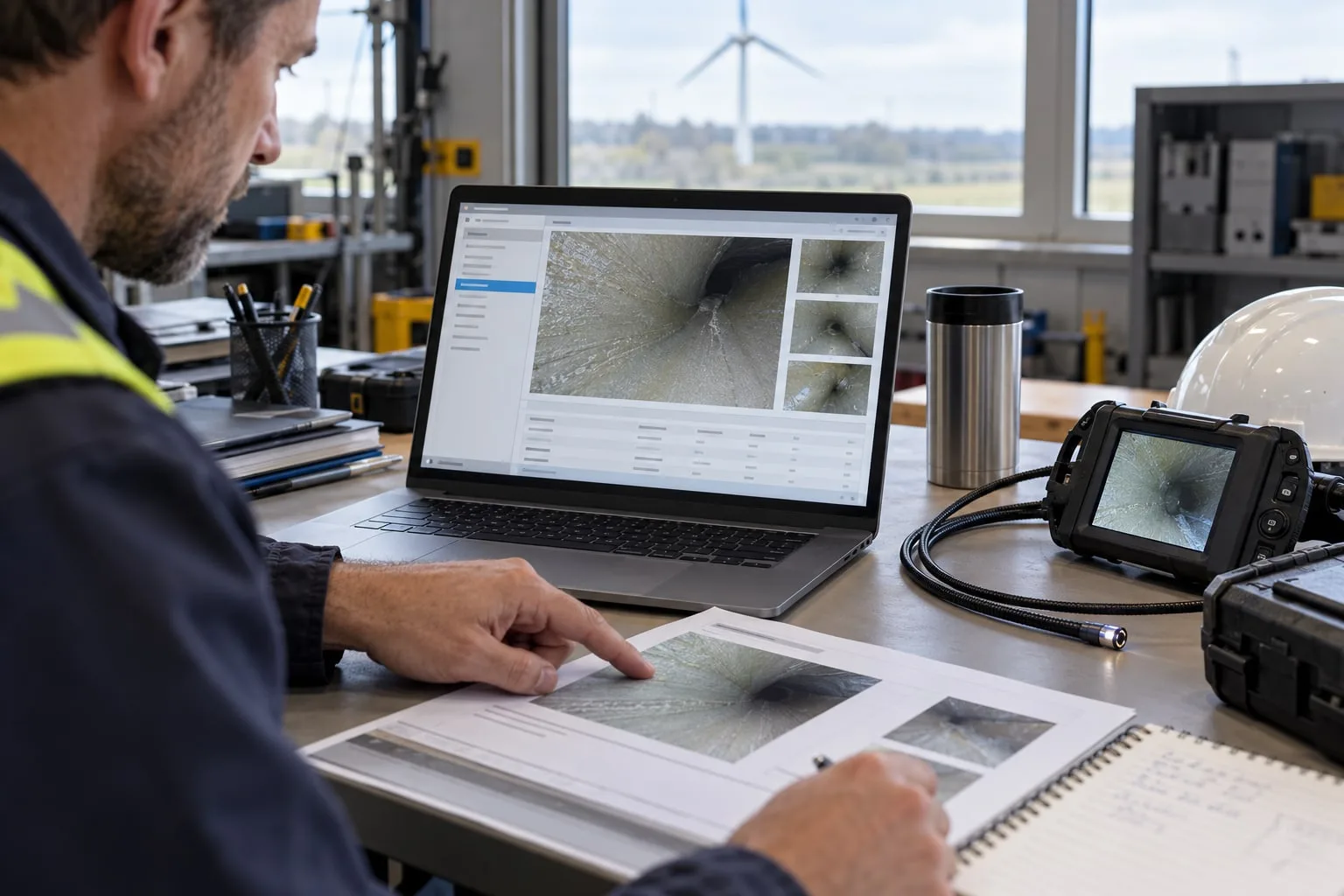
Limitation: citing DNV-ST-0376 does not establish that any report or robot conforms to it, and the standard does not prescribe this report layout. The page states no repair thresholds, and it has not been approved by a named engineer. The illustration is generic and not a software screen or customer record.
See the source and editorial policy for how product values, external references and review status are kept separate.
Decision support
Frequently asked questions
Is an AI-generated defect list a complete report?
No. It needs asset context, source evidence, coverage limitations and human review. Automated flags are inputs to review, not automatic authorization for repair or operation.
Can internal visual inspection rule out subsurface damage?
Not by itself. State the method’s limits and refer unresolved questions for suitable technical evaluation. A report should not extend a visual observation into an unsupported internal-material conclusion.
Should every report recommend a repair?
No. Depending on the evidence and applicable criteria, the next step might be additional inspection, engineering assessment or monitoring. Decisions belong to the authorized project process.
What is the difference between “no finding recorded” and “not inspected”?
“No finding recorded” means an area was inspected with evidence suitable for the agreed review and nothing was recorded. “Not inspected” means no such evidence exists. A report has to keep them distinguishable, which is why it carries separate coverage statuses.
Engineering review
Define your report before the inspection
Bring blade identifiers, coverage requirements, review criteria and preferred file formats. Agree the evidence and approval requirements first, so the inspection produces a record your team can use.